Les contraintes du processus de la traduction du langage diplomatique et politique : implications dans la transposition didactique
DOI:
https://doi.org/10.62413/cqm.2025.34Keywords:
translation, language, diplomacy, politics, didactics, didactic transpositionAbstract
This article explores the unique challenges encountered when translating diplomatic and political language, highlighting its implications for didactic transposition, meaning the application of these translations within an educational context. An analysis emphasizes the specificities of diplomatic and political language, which is characterized by often complex vocabulary, figurative expressions, subtle nuances, and specific cultural connotations, requiring a particular translation approach. Lastly, an aspect underlining the importance of a nuanced and well-informed approach to translating diplomatic and political language is discussed. Translators must be aware of cultural implications and diplomatic subtleties while maintaining the integrity of the messages when transposing these texts into the educational and pedagogical framework. Teaching translation in these fields must take these challenges into account and help learners develop the specific skills necessary to succeed in this highly specialized area.
Languages of publication: French (main text and corpus); English, Russian, and Japanese (corpus)
Title in English: The Constraints of the Translation Process of Diplomatic and Political Language: Implications for Didactic Transposition
UDC: 81
Received: May 25, 2025 | Reviewed: June 15, 2025 | Accepted for publication: June 25, 2025
Indexing & Archiving
How to cite this article according to APA Style
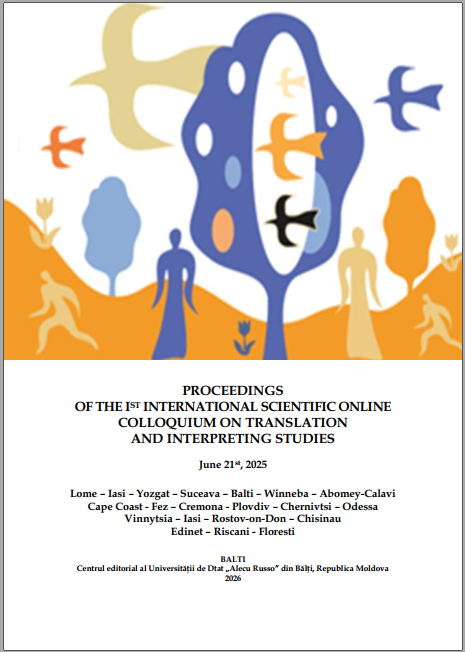
Yedibahoma, M’F. (2026). Les contraintes du processus de la traduction du langage diplomatique et politique : implications dans la transposition didactique. In: A. Coşciug & E. Foghel (Eds). 2025: Proceedings of the 1st International Scientific Online Colloquium on Translation and Interpreting Studies (pp. 411-423). Centrul editorial al Universităţii de Stat „Alecu Russo” din Bălţi. ISBN: 978-9975-50-376-1 (PDF).
Downloads
References
Bassnett, S. (2002). Translation Studies. Routledge.
Berk-Seligson, S. (2002). The Bilingual Courtroom: Court Interpreters in the Judicial Process. University of Chicago Press.
Bowker, L. (2002). Computer-Aided Translation Technology. University of Ottawa Press.
Chevallard, Y. (1985). La Transposition didactique. La Pensée sauvage
Chilton, P. (2004). Analysing Political Discourse: Theory and Practice. Routledge.
Hatim, B., & Mason, I. (1997). The Translator as Communicator. Routledge
Munday, J. (2012). Evaluation in Translation: Critical Points of Translator Decision-Making. Routledge.
Newmark, P. (1988). A Textbook of Translation. Prentice Hall.
Steiner, G. (1975). After Babel: Aspects of Language and Translation. Oxford University Press.
Trosborg, A. (1997). Analysing Professional Genres. John Benjamins.
Verreet, M. (2000). La Transposition didactique en traduction. Meta.
Wetzler, S. (2015). Diplomacy and Translation in the Early Modern World. Cambridge University Press.
Downloads
Published
Issue
Section
Categories
License
Copyright (c) 2026 International Scientific Online Colloquium on Translation and Interpreting Studies

This work is licensed under a Creative Commons Attribution-NoDerivatives 4.0 International License.