Feminine Power ‘Lost’ and Feminine Power ‘Regained’: A Comparative Study of Talbot Donaldson’s (1966), Seamus Heaney’s (1999) and Maria Dahvana Headley’s (2018) Translations of “Beowulf”
DOI:
https://doi.org/10.62413/cqm.2025.08Keywords:
“Beowulf”, “The Mere Wife”, translation, feminine power, Talbot Donaldson, Seamus Heaney, Maria Dahvana Headley, formal equivalence, dynamic equivalence, feminist transcreationAbstract
Translations of “Beowulf” often obscure the role of women in Anglo-Saxon society: formal equivalence translators, such as Talbot Donaldson (1966), replicate the text literally, but lack clarity, while dynamic equivalence translators, such as Seamus Heaney (1999), prioritize modern readability over accuracy. Both approaches diminish female authority and often reduce women to mead-bearers and mourners. Maria Dahvana Headley (2018), in her turn, breaks tradition with her subversive transcreation of “Beowulf” in the novel “The Mere Wife”, which centers on female characters. This paper compares translations of “Beowulf” by Donaldson, Heaney, and Headley, so as to reclaim the female power present in the original Old English epic but lost in subsequent patriarchal renditions.
Language of publication: English
UDC: 81
Received: May 24, 2025 | Reviewed: June 2, 2025 | Accepted for publication: June 5, 2025
Indexing & Archiving
How to cite this article according to ALA Style
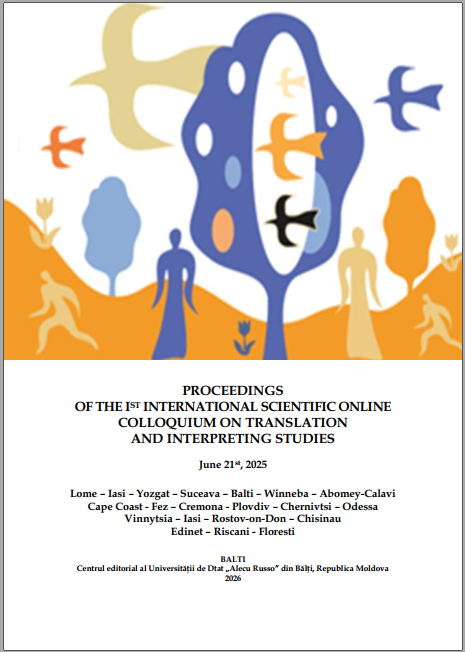
Korbut Salman, V. (2026). Feminine Power ‘Lost’ and Feminine Power ‘Regained’: A Comparative Study of Talbot Donaldson’s (1966), Seamus Heaney’s (1999) and Maria Dahvana Headley’s (2018) Translations of “Beowulf”. In: A. Coşciug & E. Foghel (Eds). 2025: Proceedings of the 1st International Scientific Online Colloquium on Translation and Interpreting Studies (pp. 71-80). Centrul editorial al Universității de Stat „Alecu Russo” din Bălți. ISBN: 978-9975-50-376-1(PDF).
Downloads
References
Bassnett, S. (2014). Translation studies. Routledge.
Bennett, H. (2018). The female mourner in Beowulf. Studies in Philology, 115(1), 66-85.
Butler, J. (1990). Gender trouble: feminism and the subversion of identity. Routledge.
Carruthers, M. (2018). The art of feminist translation. Oxford University Press.
Carruthers, L. (2020). Performance and ritual in the Anglo-Saxon world. Cambridge University Press.
Chamberlain, L. (1988). Gender and the metaphorics of translation. Signs, 13(3), 454-472.
Chance, J. (1986). Woman as hero in Old English literature. Syracuse University Press.
Chickering, H. D. (1977). Beowulf: a dual-language edition. Anchor Books.
Damico, H. (1984). Beowulf’s Wealhtheow and the Valkyrie tradition. University of Pennsylvania Press.
Dinshaw, C. (1989). Chaucer’s sexual poetics. University of Wisconsin Press.
Donaldson, E. T. (1966). Beowulf: a prose translation. Norton.
Enright, M. J. (1996). Lady with a mead cup: ritual, prophecy, and lordship in the European warband. Four Courts Press.
Finke, L. (1992). Women’s writing in English: Medieval England. Routledge.
Flotow, L. (1997). Translation and gender: translating in the ‘era of feminism’. St. Jerome.
Frank, R. (2003). The Beowulf poet’s sense of history. In The wisdom of poetry: essays in Early English literature in honour of Morton W. Bloomfield, edited by L. D. Benson and S. Wenzel, 107-118. Medieval Institute Publications.
Härke, H. (2003). Women in Early Medieval England. Oxford Journal of Archaeology, 22(2), 153-165.
Headley, M. D. (2018). The Mere Wife. MCD Books.
Headley, M.D. (2020). On translating Beowulf as a woman. Paris Review, Spring, 45-52.
Heaney, S. (1999). Beowulf: a new translation. Faber & Faber.
Hill, J. M. (1990). The cultural world in Beowulf. University of Toronto Press.
Klaeber, F. (1922). Beowulf and the fight at Finnsburg. D.C. Heath.
Lees, C. (1994). Tradition and belief: religious writing in Late Anglo-Saxon England. University of Minnesota Press.
Lees, C. (1997). Medieval masculinities. University of Minnesota Press.
Liuzza, R. M. (2013). Beowulf: facing page translation. Broadview Press.
Niles, J. D. (2008). Old English heroic poems and the social life of texts. Brepols.
Nida, E. A. (1964). Toward a science of translating. Brill.
Nida, E. A., and C. R. Taber. (1969). The theory and practice of translation. Brill.
Overing, G. R. (1990). Language, sign, and gender in Beowulf. Southern Illinois University Press.
Orchard, A. (2003). A critical companion to Beowulf. D.S. Brewer.
Spivak, G. C. (1993). Outside in the teaching machine. Routledge.
Simon, S. (1996). Gender in translation. Routledge.
Trask, R. M. (2005). Beowulf and Judith: two heroes. University Press of America.
Trilling, R. (2009). The aesthetics of nostalgia. University of Toronto Press.
Venuti, L. (1995). The Translator’s invisibility: a history of translation. Routledge.
Venuti, L. (2019). Contra instrumentalism. University of Minnesota Press.
Wittig, M. (1985). The mark of gender. Feminist Issues, 5(2), 3-12.
Downloads
Published
Issue
Section
Categories
License
Copyright (c) 2026 International Scientific Online Colloquium on Translation and Interpreting Studies

This work is licensed under a Creative Commons Attribution-NoDerivatives 4.0 International License.