Специфика безэквивалентности в лексической системе русского и английского языков
DOI:
https://doi.org/10.62413/cqm.2025.43Keywords:
non-equivalent vocabulary, translation, lacuna, reality, transliteration, transcription, calque, explication, hypernym, specificationAbstract
The relevance of the study lies in the growing interest in exploring foreign-language cultures, driven by the strengthening of international contacts. The aim of the research is to identify the most effective strategies for translating non-equivalent vocabulary between English and Russian. The concepts of "non-equivalent vocabulary", "realia", "lacuna" are defined; the methods of conveying the semantics of non-equivalent vocabulary in translation are described. The types of interlingual lexical non-equivalence are analyzed. The paper concludes that explication is the most effective method of conveying the semantics of non-equivalent vocabulary into English.
Languages of publication: Russian (main text and corpus) and English (corpus)
Title in English: The Specifics of Non-equivalence in the Lexical System of Russian and English Languages
UDC: 81
Received: June 1, 2025 | Reviewed: June 12, 2025 | Accepted for publication: June 15, 2025
Indexing & Archiving
How to cite this article according to APA Style
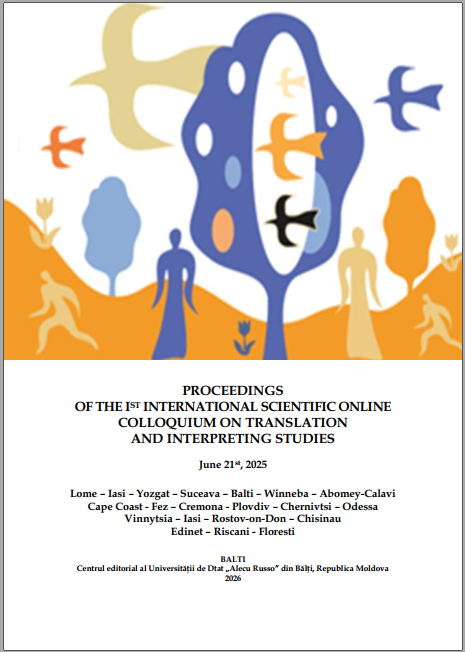
Babiuc, Al. (2026). Специфика безэквивалентности в лексической системе русского и английского языков. In: A. Coşciug & E. Foghel (Eds). 2025: Proceedings of the 1st International Scientific Online Colloquium on Translation and Interpreting Studies (pp. 512-517). Centrul editorial al Universităţii de Stat „Alecu Russo” din Bălţi. ISBN: 978-9975-50-376-1 (PDF).
Downloads
References
Астафьева, А., Широков, К. (2021). Безэквивалентная лексика и лакуны в английском языке (обзор литературы). International Journal of Advanced Studies in Language and Communication, 2 / Astafʹeva, A.D., Širokov, K.R. (2021). Bezèkvivalentnaja leksika i lakuny v anglijskom jazyke (obzor literatury). International Journal of Advanced Studies in Language and Communication, 2.
Иванов, А. (2006). Безэквивалентная лексика. СПбГУ / Ivanov, A. (2006). Bezèkvivalentnaja leksika. SPbGU.
Казмерчук, К. (2024). Безэквивалентная лексика в русском и английском языках. B: Студенты - науке и практике АПК: материалы 109-й Международной научно-практической конференции студентов и магистрантов (г. Витебск, 24 мая 2024 г.), Ч. 2 / Kazmerčuk, K. (2024). Bezèkvivalentnaja leksika v russkom i anglijskom jazykah. In: Studenty - nauke i praktike APK: materialy 109-j Meždunarodnoj naučno-praktičeskoj konferencii studentov i magistrantov (g. Vitebsk, 24 maja 2024 g.), Č. 2.
Огурцова, О. (1979). К проблеме лакунарности. B: Функциональные особенности лингвистических единиц: сб. тр. Кубан. ун-та. Вып. 3. Краснодар / Ogurcova, O. (1979). K probleme lakunarnosti. In: Funkcionalʹnye osobennosti lingvističeskih edinic: sb. tr. Kuban. un-ta. Vyp. 3. Krasnodar.
Чернов, Г. (1958). К вопросу о передаче безэквивалентной лексики при переводе советской публицистики на английский язык. Высшая школа / Černov, G. (1958). K voprosu o peredače bezèkvivalentnoj leksiki pri perevode sovetskoj publicistiki na anglijskij jazyk. Vysšaja škola.
Downloads
Published
Issue
Section
Categories
License
Copyright (c) 2026 International Scientific Online Colloquium on Translation and Interpreting Studies

This work is licensed under a Creative Commons Attribution-NoDerivatives 4.0 International License.