Traducerea literaturii de ficțiune în epoca digitală: între text, cod şi interpretare
DOI:
https://doi.org/10.62413/cqm.2025.23Keywords:
translation, fiction, digital age, text, code, interpretationAbstract
This paper explores the role of digital humanities (DH) in reshaping both the theory and practice of fiction literature translation in the digital age. It starts from the premise that literary translation is no longer solely a linguistic operation but a complex, digitally mediated act that combines textual interpretation with algorithmic processing. The study examines how DH tools – such as textual corpora, stylometric analysis, visualization platforms (e.g., Voyant Tools), and neural machine translation systems (e.g., DeepL, ChatGPT) – contribute to a better understanding of literary style, narrative coherence, and cultural transfer in translated fiction. By integrating perspectives from translation studies, stylistics, and digital text analysis, the paper argues that the intersection of text, code, and interpretation fundamentally transforms both how we translate and how we analyze translations. A practical case study illustrates how digital tools can assist in the comparative analysis of a source text and its translation, focusing on stylistic shifts and interpretive choices. The conclusion highlights that digitalization does not replace the literary translator but redefines their role, expanding their toolkit and encouraging new interdisciplinary approaches to fiction literature translation.
Language of publication: Romanian
Title in English: Translating Fiction in the Digital Age: between Text, Code and Interpretation
UDC: 81
Received: June 1, 2025 | Reviewed: June 16, 2025 | Accepted for publication: June 25, 2025
Indexing & Archiving
How to cite this article according to APA Style
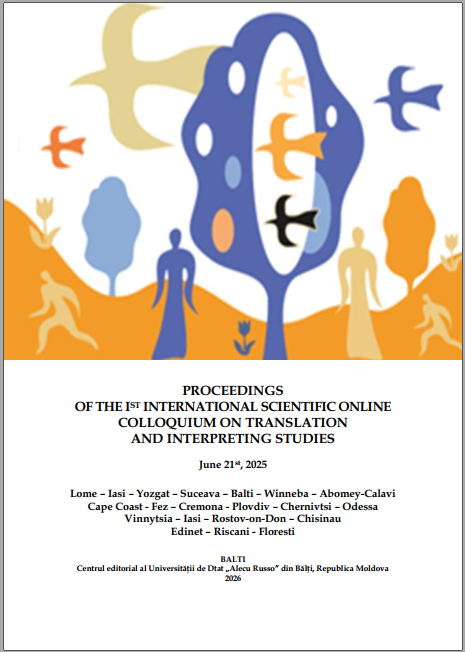
Ilie, Al. (2026). Traducerea literaturii de ficțiune în epoca digitală: între text, cod şi interpretare. In: A. Coşciug & E. Foghel (Eds). 2025: Proceedings of the 1st International Scientific Online Colloquium on Translation and Interpreting Studies (pp. 270-279). Centrul editorial al Universităţii de Stat „Alecu Russo” din Bălţi. ISBN: 978-9975-50-376-1 (PDF).
Downloads
References
Greimas, A. J. (1986). Sémantique structurale. Recherche de méthode. Presses Universitaires de France.
Ilie, A. (2004a). Impactul traducerii automate asupra învățării limbii române ca limbă străină în Discurs polifonic în Româna ca limbă străină (RLS). În: Actele Conferinței Internaționale, ediția a IV‐a/2023, nr. 4/2024. Presa Universitară Clujeană (pp. 358–373).
Ilie, A. (2024b). Traducerea automată a literaturii. O himeră încă vie? În: Cultural Dynamics of Values. Interdisciplinary Perspectives in Humanities and Social Sciences. Editura Universităţii „Alexandru Ioan Cuza” din Iași.
Reiß, K. (1986). Möglichkeiten und Grenzen der Übersetzungskritik. Max Hueber Verlang.
Sinclair, J. D. (1991). Corpus, Concordance, Collocation. Oxford University Press.
Ubersfeld, A. (1993). Lire le théâtre. Éditions sociales.
Downloads
Published
Issue
Section
Categories
License
Copyright (c) 2026 International Scientific Online Colloquium on Translation and Interpreting Studies

This work is licensed under a Creative Commons Attribution-NoDerivatives 4.0 International License.